
What is Fentanyl Murder?
Fentanyl murder is defined in Penal Code 19.02(b)4 and refers the criminal charge arising out of the delivery or manufacturing of fentanyl that results in a death. Fentanyl is a synthetic opioid that is fatal in even small doses.
Why Did the Fentanyl Murder Statute Become Law?
The rise of fentanyl-related deaths has been alarming, with the opioid crisis taking a significant toll on communities across the United States, including Texas. Fentanyl is up to 100 times more potent than morphine, and even a small dose can be lethal. House Bill 6 (HB6) was introduced to address this crisis and it became the law effective September 1, 2023. HB6 effectively reclassified fentanyl overdoses as “poisonings” and established the new offense of fentanyl murder.
This legislation aims to curb the growing number of fentanyl-related deaths by holding suppliers and distributors criminally accountable. Yet, as we will discuss in this article, that worthy goal has given law enforcement a brush that is sometimes used too broadly.
Fentanyl in Texas
Any death from fentanyl use is one death too many. One of the things that HB6 did was to implement better record-keeping. Prior to HB6 a fentanyl death would likely be categorized with other drug deaths as a drug overdose. The CDC reported that 5,489 people died in Texas from drug overdoses in 2022.
The newly enacted law in Texas requires medical examiners to specifically record fentanyl deaths as such, rather than as general drug overdoses. Abbott pointed out that in 2022, more than 2,000 people died from fentanyl in Texas, equating to over five deaths per day. He stressed that fentanyl is the leading cause of death for Americans aged 18-45.
According to the Texas Department of State Health Services, the number of fentanyl-related deaths has been on a steep rise. Data indicates that from 2019 to 2021, the number of fentanyl-related deaths in Texas increased by over 400%, highlighting the severity of the crisis.

The Fentanyl Murder Statute – Penal Code 19.02(b)(4)
The fentanyl murder statute is an addition to the murder statute, and provides murder includes:
knowingly manufactures or delivers a controlled substance included in Penalty Group 1-B under Section 481.1022, Health and Safety Code, in violation of Section 481.1123, Health and Safety Code, and an individual dies as a result of injecting, ingesting, inhaling, or introducing into the individual’s body any amount of the controlled substance manufactured or delivered by the actor, regardless of whether the controlled substance was used by itself or with another substance, including a drug, adulterant, or dilutant.
The Intent Requirement of the Fentanyl Murder Statute
Notice that the intent requirement “knowingly” applies to the manufacture or delivery of fentanyl. It does not apply to the death. In other words, the law does not require a person to intend on killing another, or even know that a death will occur. At a dealer or manufacturer level, that makes sense. The dealer and the manufacturer know what they are dealing is deadly. As we will discuss further in this article, it becomes less clear when this law applies to someone who is neither a manufacturer or dealer.
Punishment for Fentanyl Murder
Fentanyl murder is a first-degree felony punishable by 5-99 years or life in prison and up to a $10,000 fine.

A Criticism of the Fentanyl Murder Statute
It is absolutely true that one pill can kill and that we should take fentanyl seriously. It is also true that manufacturers and dealers of fentanyl (or any drug containing or laced with fentanyl) should be held criminally responsible for the deaths they caused.
What may be surprising to many who have not had reason to think about the criminal laws in Texas, are those are not the only people this law applies to. The new law doesn’t target just manufacturers and dealers. It targets anyone who manufactures or delivers fentanyl.
Colloquially, when we say dealer, we think about someone who is profiting in some way from the delivery of drugs.
When we use the word “delivery” in criminal law in Texas, as the fentanyl murder statute does here, the law does not distinguish from a person who uses drug and shares it with a fellow user or fellow addict from a person who is dealing drugs.
The Health and Safety Code definition is as follows:
“Deliver” means to transfer, actually or constructively, to another a controlled substance, counterfeit substance, or drug paraphernalia, regardless of whether there is an agency relationship. The term includes offering to sell a controlled substance, counterfeit substance, or drug paraphernalia.
As a result, law enforcement is and has been going after the seemingly low-hanging fruit of people who share drugs. It’s often easy to know who was doing drugs with someone who overdosed. In many instances, that’s the person who ends up calling the police. Far too often, what we see are murder charges filed against these individuals.
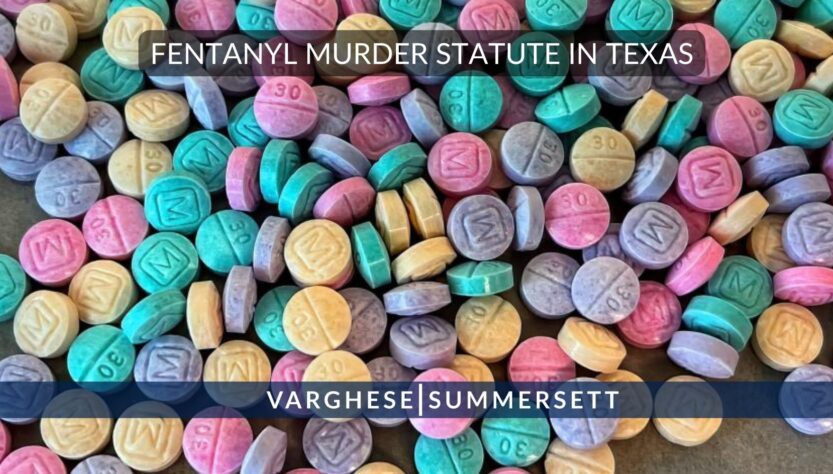
As a practical matter, as a defense attorney, the first thing I am looking at is the mental state requirement. It is far too often the case that individuals who overdosed on fentanyl believed they had purchased a prescription drug. Fentanyl can be pressed to look like anything – from a multivitamin to any other known narcotic.
What we have seen is when law enforcement puts in the effort to go after an actual dealer or manufacturer of fentanyl, jurors impose high sentences.
Only time will tell if juries feel the same way about two people who used drugs together, neither of them ever sold to another person, and one ends up dead after they share fentanyl.
Recent Fentanyl Murder Defense Victory

Varghese Summersett recently defended an individual charged with the death of a Tarrant County judge based on the new fentanyl murder statute. The grand jury ultimately no-billed the charge against our client. Varghese Summersett attorney Tiffany Burks, said the following:
“We are grateful to the grand jury for their careful review of this case, which led to the decision not to indict my client on a fentanyl murder charge. Any drug overdose resulting in death is a tragedy. We continue to extend our deepest condolences to the friends and family mourning the loss of [the] former [j]udge[].”
